
The Flirt Pole That Tires Out a Dog Your Walk Cannot
One telescopic handle, one braided cotton rope. Wave it, and your dog sprints, turns, catches and pulls. Ten minutes of that does what forty minutes of walking does not.
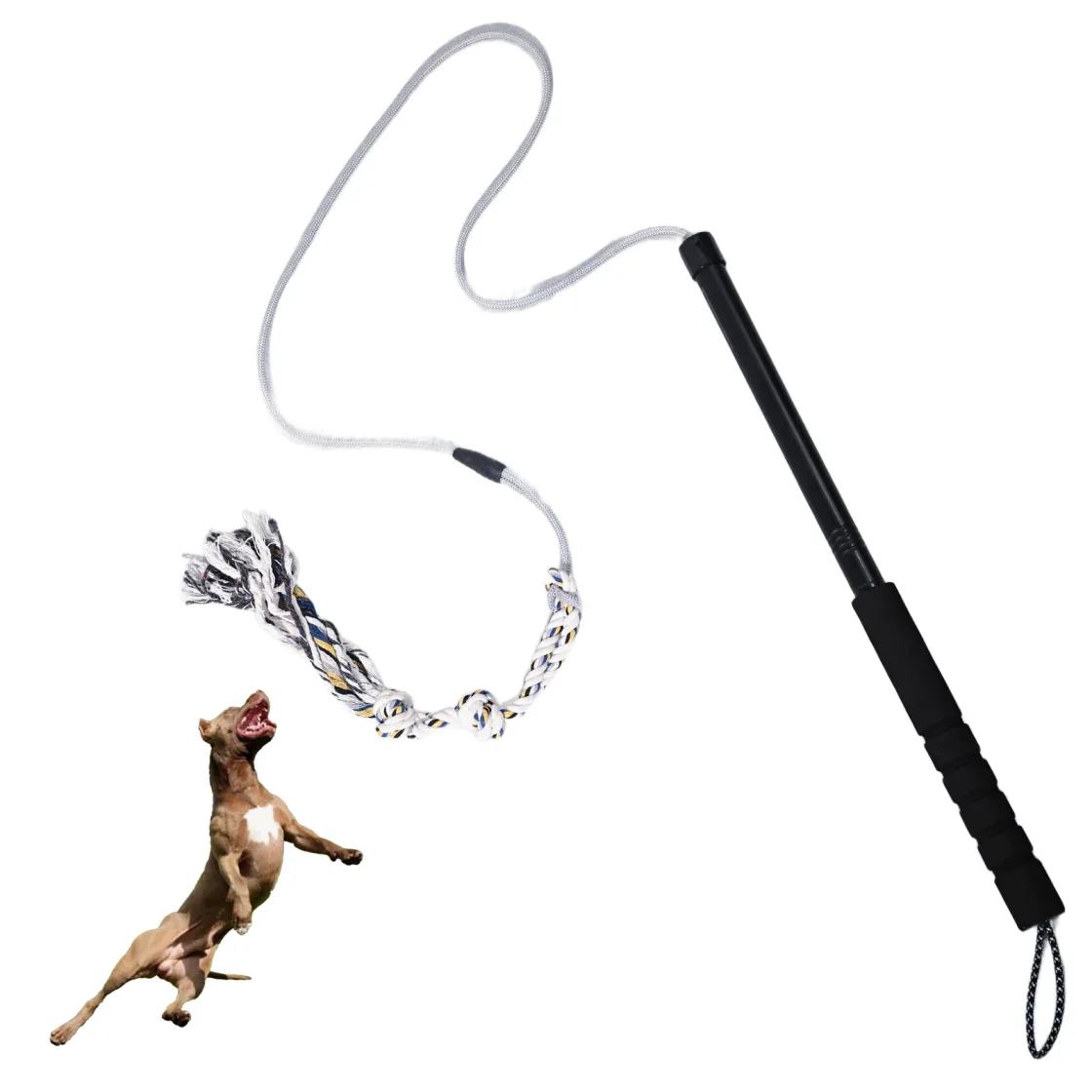
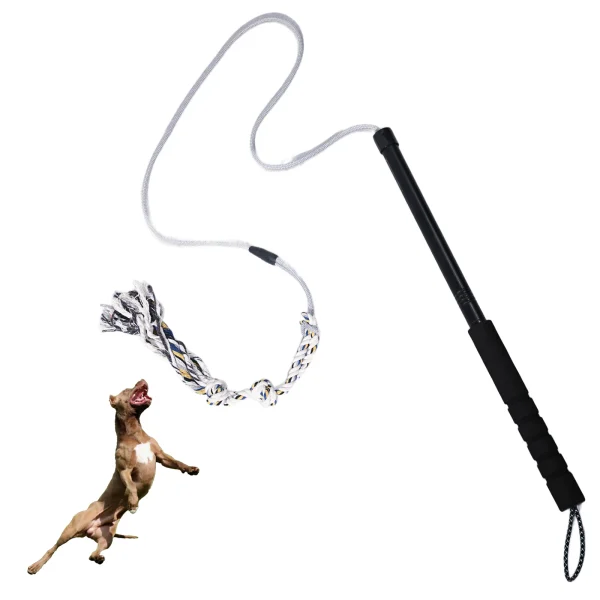
A Walk Moves a Dog. A Chase Empties One.
Most dogs on a lead walk at human pace, in a straight line, on a surface that never surprises them. That is exercise in the loosest sense. It moves the legs and it empties the bladder, and for a lot of dogs it changes nothing about the restlessness that shows up at seven in the evening.
Chasing is different work. A dog that chases accelerates, brakes, turns on one shoulder, judges a moving target and closes its jaws on it. That whole sequence is wired in, and running it properly is closer to a set of sprints than to a stroll. It also finishes somewhere, because the dog catches the thing. A walk has no catch, so the drive it raised is still there when you get home.
The flirt pole exists because that sequence normally needs a field and a second dog. On a pole, it needs a few square metres and one person standing still.
Three Things That Decide Whether a Flirt Pole Survives
The lure is braided cotton, not webbing
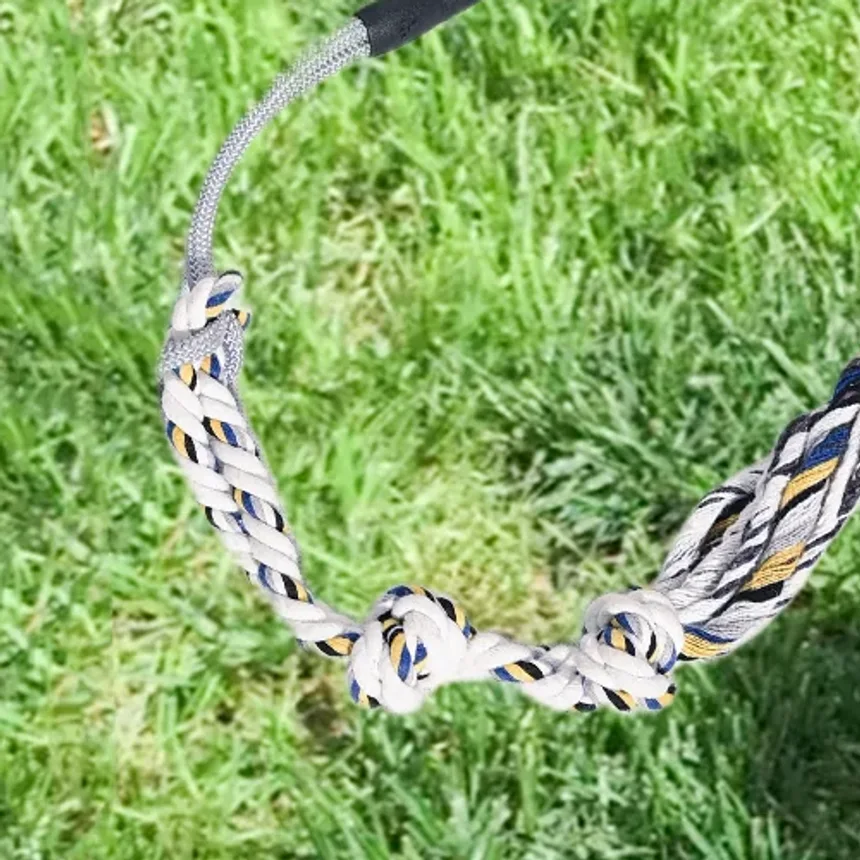
The lure on this pole is braided pure cotton, finished in a frayed tassel. Cotton takes a bite and gives under it, which is what makes a dog commit to the grab instead of mouthing it and letting go.
The cheap end of this category uses flat nylon webbing or a strip of fleece. Both look fine in a photo and both go the same way: a dog with any jaw strength shreds the edge on the second or third session, and what is left is a fraying strap that catches on teeth.
Braided rope behaves differently under a bite. It compresses, springs back and keeps its shape, and the frayed tassel at the end gives the dog something obvious to aim for. Buyers describe it as very durable, and as bouncy and elastic, which is the same property read from the other side.
The grip unscrews
The padded foam grip screws onto the handle and comes off. That matters for storage more than for play, because with the grip removed the pole drops to a length that fits a car door pocket or a hook by the back door.
A buyer who found the full assembly bulky worked out that the padded grip unscrews, and it is the kind of detail that only shows up once someone owns the thing.
It also means the handle is a real assembly rather than a moulded stick. Parts that come apart are parts you can replace or clean, and a rope lure that has taken a season of teeth can be untied and swapped without throwing the pole away.
It holds up to big dogs
The maker pitches this pole at small and medium dogs. The buyers who own one say otherwise, and one of them runs it with a Rottweiler crossed with a Dogue de Bordeaux. The strongest complaint from buyers is that the handle is on the large side.
That buyer owns one of the heaviest working crosses there is, and writes that the toy was honestly more durable than expected.
Read the complaints the same way. Nobody reports a snapped handle or a rope pulled apart. The recurring criticism is that the assembled pole is bulky, which is a size problem rather than a strength problem, and it is the one the unscrewable grip answers.
Flirt Pole, Motorised Lure Course, or a Ball Thrower
Three tools claim the same job. They cost between twenty dollars and several hundred, and they do not do the same thing.
| Tool | What it actually trains | What it costs you |
|---|---|---|
| Flirt pole | Sprint, turn, catch and tug, with you controlling every change of direction | Around $30, and you have to work it by hand |
| Motorised lure course | Flat-out running in a loop, hands off, with no catch at the end | Several hundred dollars, plus batteries, pulleys and a field to lay it out in |
| Ball thrower | Repeated straight-line sprints in one direction | Cheap, but it needs open space and it builds a one-sided habit |
The Flirt Pole, by the Numbers
length of a typical American lure course, the sport this toy borrows from
— American Kennel Club, 2026
across 27 verified ratings
of cord between the telescopic handle and the braided cotton lure
The Three Questions Buyers Ask Us Most
| Question | Straight answer |
|---|---|
| Is there a spare lure? | Not included. If the rope goes, you can untie it and fit your own. |
| Does it replace a walk? | No. It replaces the part of the walk that was supposed to tire the dog out. |
| Is it right for a puppy? | Keep it low and slow. Hard turns are rough on joints that are still growing. |
The 30-day return covers anything these answers do not.
Sighthounds generally have no need to be trained or enticed to chase the lure, since the desire to chase is instinctual.— American Kennel Club, on getting started in lure coursing, 2026
How to run a session without hurting anyone
Five minutes, a flat surface, and a rule about letting the dog win
Work on grass or dirt, never on a hard floor or a slippery one. The whole point of the toy is fast turning, and fast turning on tile is how a dog pulls something.
Keep the lure on the ground. Dogs that leap for a lure land badly, and a lure held at head height turns a chase into a series of jumps. Sweeping low also keeps the dog driving forward rather than rearing up at you.
Let the dog catch it, often. A chase that never ends is frustrating rather than satisfying, and a dog that never wins stops committing to the sprint. Let it catch, let it tug for a few seconds, trade the lure for a treat, and start again.
Stop before the dog wants to. Five minutes of this is a real workout. Ending while there is still enthusiasm left is what makes the pole something the dog is glad to see next time.
Skip it entirely with a dog recovering from a joint injury, and go gently with puppies. The turns are the useful part and they are also the demanding part.
Specifications
| Lure material | Braided pure cotton, frayed tassel end |
| Handle | Telescopic, with a padded foam grip that unscrews |
| Colour | Black handle, grey rope with blue and gold threads |
| Cord length | 43.3 in (110 cm) |
| Handle length | 20.4 in (52 cm) extended, telescopic |
| Lure length | 15.7 in (40 cm) |
| Cord material | Braided nylon |
Rated 4.7 / 5 across 27 verified buyers
Twenty-seven people rated this pole, and twenty-five of them gave it five stars.
"My dog loved it, congratulations to the entire team. For the speed of delivery and the quality of the product."
— Verified buyer
"Came quicker than everything else I ordered, just in time for my new puppy. Very very durable which honestly shocked me. I have a rottweiler x dogue de bordeaux."
— Verified buyer
Flirt Pole Questions, Answered Straight
What is a flirt pole for dogs?
A flirt pole is a long handle with a cord and a lure on the end. You sweep the lure along the ground and the dog chases, catches and tugs it. It is a hand-powered version of the lure that sighthounds run after in lure coursing, scaled down to a garden.
How long should a flirt pole session last?
Five to ten minutes is a full workout for most dogs. The sprint-and-turn pattern is far more demanding than it looks, and stopping while the dog still wants more keeps the toy exciting rather than exhausting.
Is a flirt pole safe for my dog?
On grass or dirt, with the lure kept low, yes. Avoid hard or slippery floors, do not make the dog leap for the lure, and let it catch the lure regularly. Skip it with dogs recovering from joint injuries and go gently with growing puppies.
Will this flirt pole hold up to a large dog?
Buyers use this pole with large dogs, including a Rottweiler crossed with a Dogue de Bordeaux, and none of the twenty-seven ratings reports a broken handle or a torn rope. The pole has no published load rating.
How long is the pole?
The telescopic handle measures 20.4 inches extended, the cord 43.3 inches and the braided lure 15.7 inches, so at full stretch you are sweeping the lure roughly five feet from your hand. Owners describe the assembled pole as bulky, and the padded grip unscrews to make it shorter for storage.
What is the lure made of?
Braided pure cotton, finished in a frayed tassel. Cotton compresses under a bite and springs back, which is why it survives repeated grabbing better than the flat nylon webbing used on cheaper poles.
Can I use a flirt pole indoors?
Not really. The toy works by making a dog turn hard at speed, and turning hard on a wooden or tiled floor is exactly how dogs slip and strain something. Grass or packed dirt, with room to sweep the lure in a full circle.
Does a flirt pole replace walks?
No. It replaces the part of the walk that was meant to tire the dog out. Dogs still need to sniff, see other dogs and change scenery, and a flirt pole does none of that. Use it on the days the walk clearly was not enough.
Ten Minutes Beats Forty
One pole, one cotton rope, free shipping and thirty days to change your mind.
Get your flirt pole →